Introduction
Data Structure can be defined as the group of data elements which provides an efficient way of storing and organising data in the computer so that it can be used efficiently. Some examples of Data Structures are arrays, Linked List, Stack, Queue, etc. Data Structures are widely used in almost every aspect of Computer Science i.e. Operating System, Compiler Design, Artifical intelligence, Graphics and many more.Data Structures are the main part of many computer science algorithms as they enable the programmers to handle the data in an efficient way. It plays a vitle role in enhancing the performance of a software or a program as the main function of the software is to store and retrieve the user's data as fast as possible
Need of Data Structures
As applications are getting complexed and amount of data is increasing day by day, there may arrise the following problems:
Processor speed: To handle very large amout of data, high speed processing is required, but as the data is growing day by day to the billions of files per entity, processor may fail to deal with that much amount of data.
Data Search: Consider an inventory size of 106 items in a store, If our application needs to search for a particular item, it needs to traverse 106 items every time, results in slowing down the search process.
Multiple requests: If thousands of users are searching the data simultaneously on a web server, then there are the chances that a very large server can be failed during that process
in order to solve the above problems, data structures are used. Data is organized to form a data structure in such a way that all items are not required to be searched and required data can be searched instantly.
Advantages of Data Structures
Efficiency: Efficiency of a program depends upon the choice of data structures. For example: suppose, we have some data and we need to perform the search for a perticular record. In that case, if we organize our data in an array, we will have to search sequentially element by element. hence, using array may not be very efficient here. There are better data structures which can make the search process efficient like ordered array, binary search tree or hash tables.
Reusability: Data structures are reusable, i.e. once we have implemented a particular data structure, we can use it at any other place. Implementation of data structures can be compiled into libraries which can be used by different clients.
Abstraction: Data structure is specified by the ADT which provides a level of abstraction. The client program uses the data structure through interface only, without getting into the implementation details.
Advantages of Data Structures
Efficiency: Efficiency of a program depends upon the choice of data structures. For example: suppose, we have some data and we need to perform the search for a perticular record. In that case, if we organize our data in an array, we will have to search sequentially element by element. hence, using array may not be very efficient here. There are better data structures which can make the search process efficient like ordered array, binary search tree or hash tables.
Reusability: Data structures are reusable, i.e. once we have implemented a particular data structure, we can use it at any other place. Implementation of data structures can be compiled into libraries which can be used by different clients.
Abstraction: Data structure is specified by the ADT which provides a level of abstraction. The client program uses the data structure through interface only, without getting into the implementation details.
Data Structure Classification
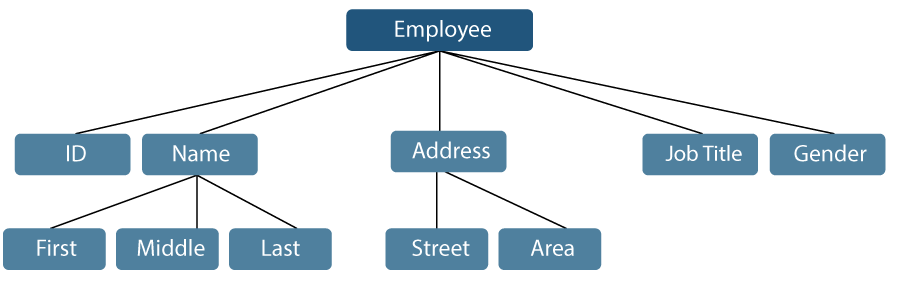
Linear Data Structures: A data structure is called linear if all of its elements are arranged in the linear order. In linear data structures, the elements are stored in non-hierarchical way where each element has the successors and predecessors except the first and last element.
Types of Linear Data Structures are given below:
Arrays: An array is a collection of similar type of data items and each data item is called an element of the array. The data type of the element may be any valid data type like char, int, float or double.
The elements of array share the same variable name but each one carries a different index number known as subscript. The array can be one dimensional, two dimensional or multidimensional.
The individual elements of the array age are:
age[0], age[1], age[2], age[3],......... age[98], age[99].
Linked List: Linked list is a linear data structure which is used to maintain a list in the memory. It can be seen as the collection of nodes stored at non-contiguous memory locations. Each node of the list contains a pointer to its adjacent node.
Stack: Stack is a linear list in which insertion and deletions are allowed only at one end, called top.
A stack is an abstract data type (ADT), can be implemented in most of the programming languages. It is named as stack because it behaves like a real-world stack, for example: - piles of plates or deck of cards etc.
Queue: Queue is a linear list in which elements can be inserted only at one end called rear and deleted only at the other end called front.
It is an abstract data structure, similar to stack. Queue is opened at both end therefore it follows First-In-First-Out (FIFO) methodology for storing the data items.
Non Linear Data Structures: This data structure does not form a sequence i.e. each item or element is connected with two or more other items in a non-linear arrangement. The data elements are not arranged in sequential structure.
Types of Non Linear Data Structures are given below:
Trees: Trees are multilevel data structures with a hierarchical relationship among its elements known as nodes. The bottommost nodes in the herierchy are called leaf node while the topmost node is called root node. Each node contains pointers to point adjacent nodes.
Tree data structure is based on the parent-child relationship among the nodes. Each node in the tree can have more than one children except the leaf nodes whereas each node can have atmost one parent except the root node. Trees can be classfied into many categories which will be discussed later in this tutorial.
Graphs: Graphs can be defined as the pictorial representation of the set of elements (represented by vertices) connected by the links known as edges. A graph is different from tree in the sense that a graph can have cycle while the tree can not have the one.
Operations on data structure
1) Traversing: Every data structure contains the set of data elements. Traversing the data structure means visiting each element of the data structure in order to perform some specific operation like searching or sorting.
Example: If we need to calculate the average of the marks obtained by a student in 6 different subject, we need to traverse the complete array of marks and calculate the total sum, then we will devide that sum by the number of subjects i.e. 6, in order to find the average.
2) Insertion: Insertion can be defined as the process of adding the elements to the data structure at any location.
If the size of data structure is n then we can only insert n-1 data elements into it.
3) Deletion:The process of removing an element from the data structure is called Deletion. We can delete an element from the data structure at any random location.
If we try to delete an element from an empty data structure then underflow occurs.
4) Searching: The process of finding the location of an element within the data structure is called Searching. There are two algorithms to perform searching, Linear Search and Binary Search. We will discuss each one of them later in this tutorial.
5) Sorting: The process of arranging the data structure in a specific order is known as Sorting. There are many algorithms that can be used to perform sorting, for example, insertion sort, selection sort, bubble sort, etc.
6) Merging: When two lists List A and List B of size M and N respectively, of similar type of elements, clubbed or joined to produce the third list, List C of size (M+N), then this process is called merging.
Characteristics of an Algorithm
An algorithm must follow the mentioned below characteristics:
- Input: An algorithm must have 0 or well defined inputs.
- Output: An algorithm must have 1 or well defined outputs, and should match with the desired output.
- Feasibility: An algorithm must be terminated after the finite number of steps.
- Independent: An algorithm must have step-by-step directions which is independent of any programming code.
- Unambiguous: An algorithm must be unambiguous and clear. Each of their steps and input/outputs must be clear and lead to only one meaning.
PSEUDOCODE:
•One of the tools to
define algorithm.
•It is an english like representation
of the algorithm logic.
•Partly english,partly
structured code.
•English part-provides
a relaxed syntax that describes what must be done without showing
unnecessary
details like error messages.
Code part-consists of
an extended version of the basic algorithmic constructs-sequence, selection
and
iteration.
Statement
constructs:
•Sequence
–One or more statements that do not alter the execution
path within an algorithm.
•Selection
–Evaluates a condition and executes zero or more
alternatives.
•Looping
–Iterates a block of code.
Linked List Data Structure
A linked list is a linear data structure, in which the elements are not stored at contiguous memory locations. The elements in a linked list are linked using pointers as shown in the below image:
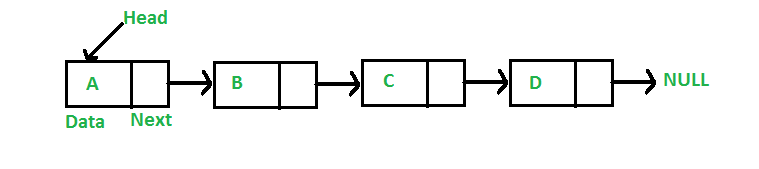
In simple words, a linked list consists of nodes where each node contains a data field and a reference(link) to the next node in the list.
Circular Linked List
Circular linked list is a linked list where all nodes are connected to form a circle. There is no NULL at the end. A circular linked list can be a singly circular linked list or doubly circular linked list.

Advantages of Circular Linked Lists:
1) Any node can be a starting point. We can traverse the whole list by starting from any point. We just need to stop when the first visited node is visited again.
1) Any node can be a starting point. We can traverse the whole list by starting from any point. We just need to stop when the first visited node is visited again.
2) Useful for implementation of queue. Unlike this implementation, we don’t need to maintain two pointers for front and rear if we use circular linked list. We can maintain a pointer to the last inserted node and front can always be obtained as next of last.
3) Circular lists are useful in applications to repeatedly go around the list. For example, when multiple applications are running on a PC, it is common for the operating system to put the running applications on a list and then to cycle through them, giving each of them a slice of time to execute, and then making them wait while the CPU is given to another application. It is convenient for the operating system to use a circular list so that when it reaches the end of the list it can cycle around to the front of the list.
4) Circular Doubly Linked Lists are used for implementation of advanced data structures like Fibonacci Heap.
Circular Singly Linked List - Insertion
In a singly linked list, for accessing any node of linked list, we start traversing from the first node. If we are at any node in the middle of the list, then it is not possible to access nodes that precede the given node. This problem can be solved by slightly altering the structure of singly linked list. In a singly linked list, next part (pointer to next node) is NULL, if we utilize this link to point to the first node then we can reach preceding nodes. Refer this for more advantages of circular linked lists.
The structure thus formed is circular singly linked list look like this:
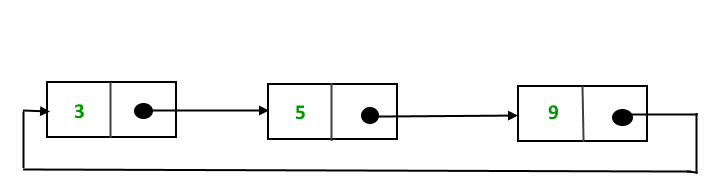
In this post, implementation and insertion of a node in a Circular Linked List using singly linked list are explained.
Implementation
To implement a circular singly linked list, we take an external pointer that points to the last node of the list. If we have a pointer last pointing to the last node, then last -> next will point to the first node.
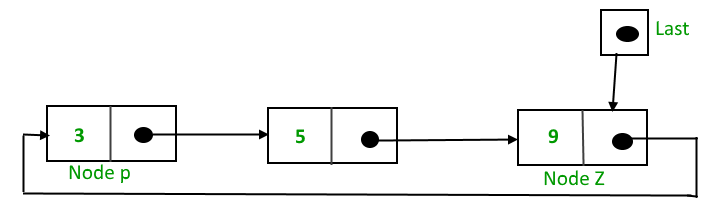
The ponter last points to node Z and last -> next points to node P.
Why have we taken a pointer that points to the last node instead of first node ?
For insertion of node in the beginning we need traverse the whole list. Also, for insertion and the end, the whole list has to be traversed. If instead of start pointer we take a pointer to the last node then in both the cases there won’t be any need to traverse the whole list. So insertion in the begging or at the end takes constant time irrespective of the length of the list.
Insertion
A node can be added in three ways:
- Insertion in an empty list
- Insertion at the beginning of the list
- Insertion at the end of the list
- Insertion in between the nodes
Insertion in an empty List
Initially when the list is empty, last pointer will be NULL.
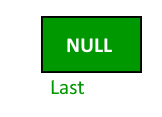
After inserting a node T,
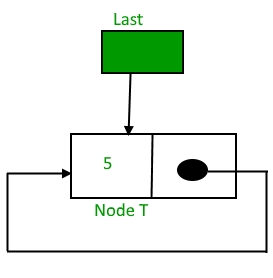
After insertion, T is the last node so pointer last points to node T. And Node T is first and last node, so T is pointing to itself.
Insertion at the beginning of the list
To Insert a node at the beginning of the list, follow these step:
1. Create a node, say T.
2. Make T -> next = last -> next.
3. last -> next = T.
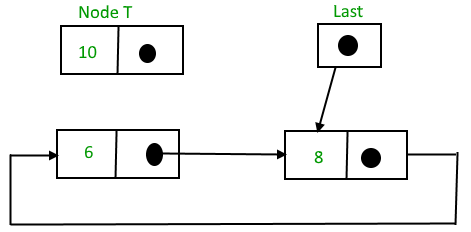
After insertion,
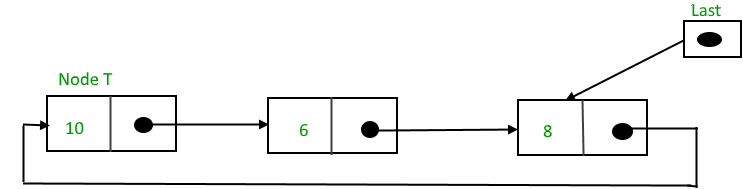
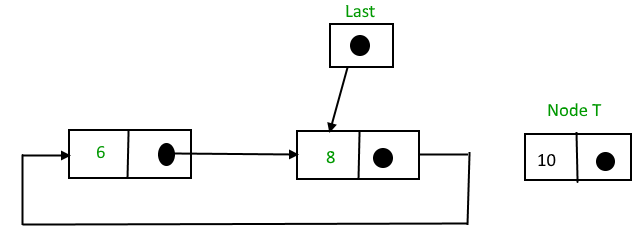
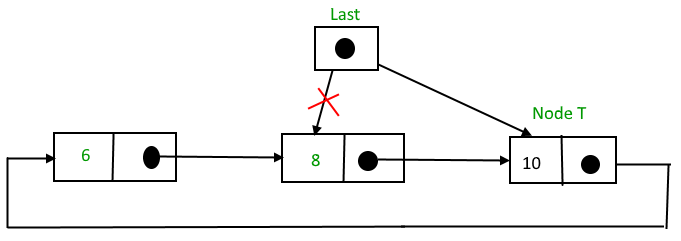 Insertion at the end of the list
To Insert a node at the end of the list, follow these step:
1. Create a node, say T.
2. Make T -> next = last -> next;
3. last -> next = T.
4. last = T.
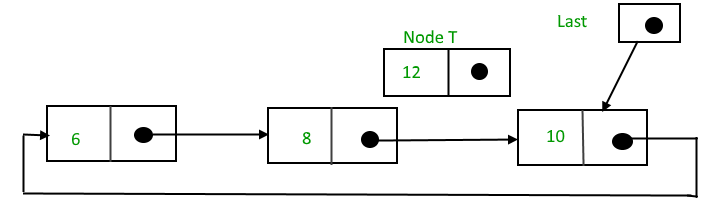
 Insertion in between the nodes
To Insert a node at the end of the list, follow these step:
1. Create a node, say T.
2. Search the node after which T need to be insert, say that node be P.
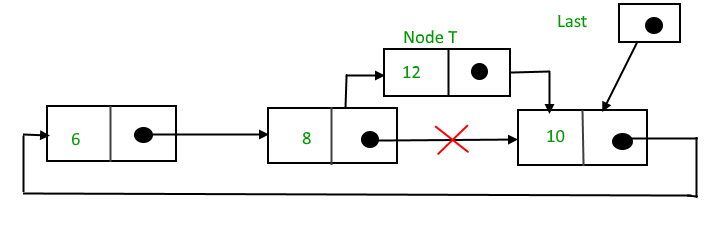
3. Make T -> next = P -> next;
4. P -> next = T.
Suppose 12 need to be insert after node having value 10,
After searching and insertion,
 A Doubly Linked List (DLL) contains an extra pointer, typically called previous pointer, together with next pointer and data which are there in singly linked list.
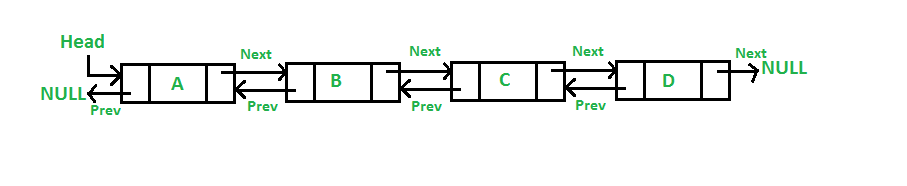 Advantages over singly linked list
1) A DLL can be traversed in both forward and backward direction.
2) The delete operation in DLL is more efficient if pointer to the node to be deleted is given.
3) We can quickly insert a new node before a given node.
In singly linked list, to delete a node, pointer to the previous node is needed. To get this previous node, sometimes the list is traversed. In DLL, we can get the previous node using previous pointer.
Disadvantages over singly linked list
1) Every node of DLL Require extra space for an previous pointer. It is possible to implement DLL with single pointer though (See this and this).
2) All operations require an extra pointer previous to be maintained. For example, in insertion, we need to modify previous pointers together with next pointers. For example in following functions for insertions at different positions, we need 1 or 2 extra steps to set previous pointer.
Insertion
A node can be added in four ways
1) At the front of the DLL
2) After a given node.
3) At the end of the DLL
4) Before a given node.
To implement a circular singly linked list, we take an external pointer that points to the last node of the list. If we have a pointer last pointing to the last node, then last -> next will point to the first node.
The ponter last points to node Z and last -> next points to node P.
For insertion of node in the beginning we need traverse the whole list. Also, for insertion and the end, the whole list has to be traversed. If instead of start pointer we take a pointer to the last node then in both the cases there won’t be any need to traverse the whole list. So insertion in the begging or at the end takes constant time irrespective of the length of the list.
A node can be added in three ways:
Insertion in an empty List
Initially when the list is empty, last pointer will be NULL.
After inserting a node T,
After insertion, T is the last node so pointer last points to node T. And Node T is first and last node, so T is pointing to itself.
To Insert a node at the beginning of the list, follow these step:
1. Create a node, say T.
2. Make T -> next = last -> next.
3. last -> next = T.
Insertion at the end of the listTo Insert a node at the end of the list, follow these step:
1. Create a node, say T.
2. Make T -> next = last -> next;
3. last -> next = T.
4. last = T.
To Insert a node at the end of the list, follow these step:
1. Create a node, say T.
2. Search the node after which T need to be insert, say that node be P.
3. Make T -> next = P -> next;
4. P -> next = T.
After searching and insertion,
1) A DLL can be traversed in both forward and backward direction.
2) The delete operation in DLL is more efficient if pointer to the node to be deleted is given.
3) We can quickly insert a new node before a given node.
In singly linked list, to delete a node, pointer to the previous node is needed. To get this previous node, sometimes the list is traversed. In DLL, we can get the previous node using previous pointer.
1) Every node of DLL Require extra space for an previous pointer. It is possible to implement DLL with single pointer though (See this and this).
2) All operations require an extra pointer previous to be maintained. For example, in insertion, we need to modify previous pointers together with next pointers. For example in following functions for insertions at different positions, we need 1 or 2 extra steps to set previous pointer.
A node can be added in four ways
1) At the front of the DLL
2) After a given node.
3) At the end of the DLL
4) Before a given node.

No comments:
Post a Comment